Wagon Train Season 4 Episode 21 No Baby at End
| Railroad vehicle Train | |
|---|---|
 | |
| Also known as |
|
| Genre | Western |
| Starring |
|
| Theme music composer |
|
| Ending theme |
|
| Composers |
|
| Country of origin | United states |
| Original language | English |
| No. of seasons | viii |
| No. of episodes | 284 (list of episodes) |
| Production | |
| Executive producers |
|
| Producers |
|
| Running time |
|
| Production companies |
|
| Distributor |
|
| Release | |
| Original network |
|
| Picture format |
|
| Audio format | Monaural |
| Original release | 18 September 1957 (1957-09-eighteen) – 2 May 1965 (1965-05-02) |
| Chronology | |
| Preceded by |
|
Railroad vehicle Train is an American Western series that aired on the NBC tv network (1957–1962) and and then on ABC (1962–1965). Carriage Train commencement aired on eighteen September 1957, and eventually placed the Boob tube prove in the number-i spot in the Nielsen ratings. The series format attracted big-proper name guest stars who appeared in major roles every bit travelers in the large railroad vehicle train or in the settlements they passed by or visited.[1] It initially starred supporting film actor Ward Bail as the railroad vehicle principal (after replaced upon his death in 1960 past supporting film actor John McIntire) and Robert Horton every bit the watch (subsequently replaced by Robert Fuller).[ citation needed ]

The series was inspired past the 1950 film Wagon Master directed past John Ford and starring Ben Johnson, Harry Carey Jr., and Ward Bond,[2] and the 1930 early widescreen film The Big Trail directed by Raoul Walsh and starring John Wayne in his first leading function as the lookout and Ward Bond in another prominent supporting function.
Overview [edit]
The series chronicles the adventures of a wagon railroad train as it makes its way from St. Joseph, Missouri, beyond the Midwestern Plains and the Rocky Mountains to Sacramento, California, and the trials and tribulations of the series regulars who conducted the railroad train through the American West.
Episodes revolved around the stories of guest characters portraying members of the massive wagon railroad train or encountered by it. These characters were often played by stars such as Ernest Borgnine, Bette Davis, Jane Wyman, Ronald Reagan, Lee Marvin and Joseph Cotten. Episode titles routinely emphasized the invitee characters with titles such every bit "The Willy Moran Story" and "The Echo Pass Story".
As a favor to Ward Bail, motion picture manager John Ford came on board to direct a 1960 segment titled "The Colter Craven Story", which included many members of the "John Ford Stock Company", momentarily featuring John Wayne speaking from the shadows and billed in the credits as "Michael Morris".[3]
Cast [edit]
The regular cast included:
- Ward Bond as wagon master Major Seth Adams (1957–61, seasons 1–4). Bond died of a heart attack in the middle of the 4th season, and was replaced by John McIntire as wagon chief. No explanation was ever given on the show.
- Robert Horton as scout Flint McCullough (1957–62, seasons 1–5).
- John McIntire as Christopher Hale (1961–65, seasons 4–8), replacing Bond equally wagon master upon Bond's decease. McIntire had guest starred in a Season 3 episode in the office of preacher Andrew Unhurt, apparently Christopher's brother according to a reference made past Christopher later in the series.
- Robert Fuller equally watch Cooper Smith (1963–65, seasons 7–8) replacing the McCullough grapheme after Robert Horton left the serial. Fuller had previously played a lead in the western serial Laramie and physically resembled Horton. Fuller and McIntire rotated tiptop billing from calendar week to calendar week on the series. Fuller fifty-fifty shared the aforementioned birthday as Horton, albeit nine years apart.
- Frank McGrath equally cook Charlie Wooster (1957–65, seasons one–8), ane of simply ii regulars to last the entire series.
- Terry Wilson as Bill Hawks (1957–65, seasons one–eight), was one of but two regulars to final the entire series.
- Michael Burns every bit Barnaby West (1960–65, seasons 6–8).
- Scott Miller (aka; Denny Miller) every bit Duke Shannon (1961–64, seasons 4–7).
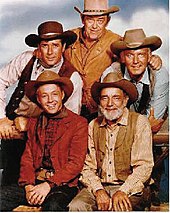
In the showtime iv seasons Ward Bond was billed above Robert Horton in the opening credits. In flavour five Horton rotated top billing with relative newcomer John McIntire, a exercise which subsequently continued with McIntire and Robert Fuller rotating summit billing from episode to episode when Fuller joined the serial in the seventh season.
During the sixth flavour, Horton had left and Fuller had not yet replaced him, so McIntire carried the evidence with the supporting cast. Neither Bond nor McIntire, both veterans of dozens of supporting roles in movies, routinely had a leading role in theatrical films, although Bond did in at least ane B-picture. Rivals Bond and Horton often quarreled on the set, an extensively publicized development at the fourth dimension, lending an element of verisimilitude to their disputes inside the episodes themselves.[ citation needed ] According to Scott Eyman in his biography of John Wayne, Bail's jealousy of Horton was fueled by Horton receiving more fan postal service. Eyman stated Bond would try to limit Horton'southward screen time and interfere with any good lines Horton might exist given in the evidence's scripts. They did eventually reconcile shortly before Bail's death.[4]
Episodes [edit]
Background and production [edit]
Evolution [edit]
Taking inspiration from John Ford'south 1950 picture Wagon Primary, Revue Productions conceived of a semi-album serial with an accent on potent storytelling and quality management with weekly invitee stars known for their piece of work in move pictures and other media but retaining a regular cast of characters to provide a touchstone for audiences.
Filming [edit]
At an initial budget of $100,000 per segment, Wagon Train episodes toll over 40% more than most contemporary hour-long Westerns, allowing it to movie on location in California's San Fernando Valley and afford its expensive guest stars.[5]
Timeline [edit]

In a kickoff-season episode Adams says the war has been over for 5 years. In season two, reference is made to the war ending six years before (1871) and to the presidential nomination of Ulysses Due south. Grant (1868), a neighbour of Adams earlier the war and eventually his commanding officer. In "The Jenna Douglas Story" (flavor five, episode 6), and again in "The Heather Mahoney Story", the year is clearly stated to be 1868 (this is more problematic since these are John McIntire/Chris Hale episodes). In "Little Girl Lost" (season eight, episode 12), Charlie states that the twelvemonth is 1869. In season three (in "The Vincent Eaglewood Story") Grant and Colfax are identified as the current President and Vice President of that time, which dates information technology as Grant's starting time term (March 1869 to March 1873); only also in season iii (in "The Countess Baranof Story") the storyline involves the impending sale of Alaska past Russian federation, simply that transaction really took place in 1867, by Secretary of State William Seward under 17th President Andrew Johnson. "The Bernal Sierra Story" (first flavor) made all-encompassing reference to the ongoing revolution in Mexico pitting republic president Benito Juárez confronting Maximilian I of Mexico (aka Emperor Maximilian installed by French emperor Napoleon Iii)--simply that insurgence ended decisively with Maximillian'due south capture and execution in 1867. Also in season three, an risk involving the Mexican revolution led past dictator Porfirio Díaz, which began in 1871 ("The Stagecoach Story", season 3, ep one, broadcast Sept 30, 1959). "The Cathy Eckhardt Story" (fourth season, broadcast 9 November 1960) clearly shows the yr is 1870, but in "The Charlene Brenton Story" (late third season, broadcast 8 June 1960) reference is made to Nib Hawks' having read the novel Ben-Hur, which was not published until a decade later in 1880. "The Sam Pulaski Story" (Season 7, episode 8, broadcase 4 November 1963) misplaces Hell'due south Kitchen equally the Brooklyn waterfront instead of the real location on the west side of mid-Manhattan, and dates the story as 1868 although the proper name "Hell's Kitchen" was not used for that neighborhood until years later. The Kickoff Transcontinental Railroad was completed in 1869, following approximately the aforementioned route equally a wagon railroad train from St. Joseph to Sacramento. This would have made wagon trains obsolete by the time most episodes in the series take place in the 1870s; however, niggling reference is made to railroads in the West during the series.
Characters [edit]
Seth Adams and Bill Hawks [edit]

Like another popular western TV series Rawhide and well-nigh of the western idiot box series of the 1950s and 1960s, the prove is gear up a few years after the American Civil War, simply whereas at that place were few Indians in Rawhide because of the usual south to due north routes and trails of the cattle drives from Texas heading northward to markets at railheads, railroad stockyards and "cattle towns" on the mid-western plains farther eastward from most Indian tribes which had already been pushed out further due west or settled on reservations in the unorganized Indian Territory (time to come Oklahoma), they often oftentimes turned up in Railroad vehicle Train crossing the western U.South. from Missouri/Iowa to California/Oregon causing the wagons to form a defensive circumvolve at nights or at any sign of assault.[ citation needed ]
In the very early episodes of the first season, Bill Hawks has a smaller role - as a passenger, non a team fellow member, referred to and addressed as "Mr. Hawks", and traveling in a wagon with his wife, Emily. Past the fourth dimension of "The Major Adams Story", later in the offset yr, he is both a team fellow member and a wagon owner - bringing his wife Emily (played by Irene Corlett and Irene Windust in different episodes) west. Emily explains that Beak and Major Adams went into the wagon train business organisation "right afterward the war" (but simply now, circa 1870, bringing his married woman westward).[ citation needed ] In "The Sacramento Story" at the end of Season 1, it is mentioned that she is left in Sacramento while Adams, Wooster, and Nib Hawks volition take a boat effectually Southward America to embark a new wagon train in the coming Spring. However, in "The Barnaby West Story" and in "The Lizabeth Ann Calhoun Story", Hawks says that he never married.
In "The Major Adams Story" information technology is explained that Seth Adams had commanded a militia grouping (patently in Philadelphia) and they enlisted en masse in the Wedlock Ground forces in 1861, that Bill Hawks was Sergeant to Major Adams and that Wooster was a belatedly enlistment as a private (in various episodes it is mentioned that their regiment was nether Generals William Tecumseh Sherman and Ulysses S. Grant). However, a unlike story in "The Colter Craven Story" (season 4), we are told that in 1860, Adams and Hawks were partners in a lumber enterprise in Galena, Illinois (Grant's pre-war home town), and on the eve of the Civil State of war, Adams headed up the 2nd Illinois Volunteers - although without a bit of military knowledge - and was given guidance by old friend "Sam", and so a resigned old captain and a civilian but afterward General of the Army U.Due south. Grant, who - encountering Adams again after the Boxing of Shiloh (Apr 1862) - gave him a battlefield promotion from Lieutenant to Major (in "The Colter Chicken Story", Flavor four, episode ix, broadcast 23 Nov 1960 - nevertheless Adams tells this story to Craven primarily to remedy Craven'south hysterical paralysis and sense of shame, so Adams may not have been entirely truthful). In "The Beth Pearson Story", in a more credible situation, Adams says he met Hawks and Wooster in the Ground forces during the war. In "The Lizabeth Ann Calhoun Story", we are again told that Hawks was a Sergeant in the Union Ground forces. In "The Willy Moran Story" it is mentioned that Major Adams fought in the Battle of Gettysburg (July 1863).
Additionally, around 1859 - perhaps before setting upward the lumber business in Galena, Adams and Hawks were (briefly) prize fight promoters in New York Urban center, by and large setting upwards matches and taking bets on their boxer, known as "the Tinsmith" ("The Dan Hogan Story", Season 1, episode 33, broadcast 14 May 1958).
In the two-part "Major Adams Story" (season one, episodes xxx, 31 broadcast 23 and 30 April 1958), viewers learn of Major Adams' Civil State of war background and his association in the Union Army with Wooster and Neb Hawks. The 2 episodes begin with Adams stopping to visit the grave of a lady love (in Arizona Territory - time to come Arizona), hundreds of miles from their established route further n across The W, whose tombstone shows that she had died in 1868. By that fourth dimension, Adams had been leading wagon trains for several years (which would tend to disharmonize with the mentions of his Civil War combat). The episode then goes into a flashback.[ citation needed ]
Flint McCullough and Charlie Wooster [edit]
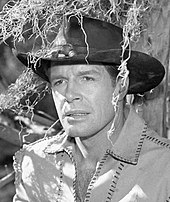
In "The Major Adams Story" (1958), Charlie Wooster was a private in the Union Army who, by run a risk, was assigned to Major Adams's visitor and promptly proved himself useless for gainsay merely claimed some experience every bit a melt and, when assigned to that position, did quite well. Wooster did non excel at anything else; so he became a cook in the Army. In the start episode he was clean-shaven, but he quickly grew a beard. McCullough had previously been a stagecoach driver. Douglas Kennedy appears in this episode as Colonel Hillary. Unremarkably, each episode is the story of one person, after whom that episode is named, and their problems are resolved through the plan.[ citation needed ]
"The Flintstone McCullough Story" (flavor two, ep fifteen trans 14 Jan 1959) is likewise largely a flashback to his cursory Ceremonious War experience in the Confederate States Army. McCullough had been born in Virginia, but both his parents died when he was a small-scale kid, evidently at Fort Bridger, Wyoming, where he was promptly adopted by the historical existent-life frontiersman, Jim Bridger (1804-1881). Circa 1862, at approximately the age of 19, McCullough felt duty bound to enlist in the Confederate Ground forces because of his Virginia nativity. He was recruited by a Col. Taylor who had established a Confederate encampment in Wyoming most Fort Bridger. It turned out that Taylor intended to utilise his western recruits not as regular soldiers but equally a guerrilla forcefulness to plunder gold shipments and the like to finance the Confederate cause. In this episode, McCullough detours from the wagon train to revisit Fort Bridger and learns he will once once more meet his former ruthless commanding officer who is responsible for war crimes (including the wanton murder of McCullough's sweetheart), and whom McCullough vowed to impale if he ever tracked him downwards; at the episode'south conclusion nosotros return to the present and the ex-officer turns upward, only for a shocked McCullough to detect that misfortune - prison experience and/or some serious disease—has left the hated man virtually a vegetable, a "punishment" apparently handed down by a higher authority. McCullough'southward adoption and training by Jim Bridger is also mentioned in "The River Crossing", and in "The Path of the Ophidian" (Feb 1961).[ citation needed ] For some years after his discharge from the Amalgamated Army, McCullough was a commuter for the Jameson Stagecoach line, between Sacramento and St. Louis ("The Stagecoach Story", season 3, ep 1, trans Sept xxx, 1959), earlier condign a scout for the wagon railroad train.
"The Artie Matthewson Story" (1961), tells a different story of Flint's early life. Duke finds Flint's dying foster mother who asks Flintstone to cheque on her real son Artie who she hasn't seen in 5 years and has a reputation for getting into trouble with the law. Flint's foster female parent dies in his arms. Yet another story is given in "The Nancy Lee Davis Story" - eight years before working for Chris Hale, McCullough was a prosperous immature man (judging from his business firm, his dress, his team of horses and his buggy) in a substantial Virginia community, engaged to marry a local debutante, but she was murdered past robbers intent on stealing the wedding gifts and silver plate prepared for the wedding reception and McCullough spent weeks, perhaps months, riding the West from town to town hunting the robbers down. The same "Nancy Lee Davis Story" likewise described (it was filmed in black-and-white) McCullough'southward hair equally scarlet.
Other backstories [edit]

In "The Sacramento Story", which was the last episode in the first season, the wagon train finally arrives in California after a three-calendar month journey. Some stars from earlier episodes announced briefly equally disembarking passengers. At the end of the testify, Flint McCullough has his $400 pay for the journey, says his goodbyes and rides off. Adams knows he'll spend the money on girls, do a number of jobs when it is gone, then find some other carriage train for which to lookout man. With all the other wagons gone, there is only Adams, Hawks and Wooster. They programme to take a ship back effectually the tip of South America and back to Boston. Instead, in the first episode of the 2nd flavor, the trio are shanghaied (kidnapped and forced to join the crew of a ship) in San Francisco but jump ship in New Orleans and end upwardly back in St. Joseph, Missouri, with McCullough gear up to take some other railroad train west. In later seasons the series was more episodic and paid less attention to the progress of the railroad train along its route over the course of the season.[ citation needed ] The season-two episode "The Final Homo" (episode 10, trans 11 Feb 1959) invitee-starred Dan Duryea as the one-half-crazed sole survivor of a "lost" carriage train that had vanished in a snowed-in pass a year earlier; Adams and McCullough, in a jointly featured story, now face up their train existence condemned to an identical fate, as their wagons are similarly stalled alongside the "expressionless" train. It is not stated but implied that the sole survivor had to resort to cannibalism every bit people died off in gild to survive—this grim episode was inspired by an actual, famous winter, carriage train disaster (the Donner Party) in 1846.[ citation needed ]
From season two, some episodes were also denoted: "This night Starring . . . " afterward the initial credit for the ii stars and show championship were put up; these were the individual featured episodes of either Ward Bond or Robert Horton. Bond'due south tales normally were set on the train, while Horton'due south would usually involve the spotter having ridden on ahead away from the train.[ commendation needed ]. After Robert Horton left the series, during John McIntire's career as Chris Hale, Terry Wilson, as Bill Hawks, alternated with McIntire as the dominance figure in episodes (even though Wilson was given third billing, after McGrath).
On six May 1959, but 4 months before he joined the new series Laramie on NBC, afterwards Wagon Railroad train costar Robert Fuller appears with Ruta Lee as a happily married immature couple in the episode "The Kate Parker Story", with Virginia Grey in the starring role. Fuller every bit Chris Finley seeks to turn from gambling and become a responsible husband. Evvie, his wife, is seriously injured in a wagon accident. The Finleys contrast strikingly with an older couple on the wagon train, Kate Parker and her husband, Jonas, played past Warren Stevens, who have a loveless marriage. Trapped in snow in the mountains, presumably the Sierra Nevada, the greedy Jonas leaves the Finleys behind to wait for reinforcements, and he forces the unwilling Kate to drive their carriage. Kate wrecks the wagon and Jonas leaves on human foot with her money. Kate is given essential shelter by illiterate mountain man Boone Caulder, played by Regal Dano, whom she finds wise despite his lack of teaching.[half-dozen]

On 3 June 1959, near the end of the second flavor, John McIntire guest starred in "The Andrew Hale Story", arguably unrelated to his afterward starring function equally wagonmaster Chris Hale (who mentioned having a preacher for a brother). This Andrew Unhurt is a minister mistakenly on the run who is plant dying in the desert. He soon displays great cognition of healing and spiritual matters and restores the religion of many on the carriage train. Others making appearances in this episode are James Best and Clu Gulager, who portrays photographer Elliott Garrison, who blackmails a young woman on the wagon train. Afterwards, Gulager portrayed Billy the Kid in a TV serial in NBC's The Tall Man,[7] and, later, joined the cast of The Virginian.[ citation needed ]
After Ward Bail'southward sudden death on 5 November 1960, several episodes featuring him were still shown, just one was held dorsum, with Robert Horton and so carrying the atomic number 82. Episodes crediting but non featuring both Bond and his replacement, John McIntire, were and so alternated for a time until the concluding Ward Bond episode was screened over a year later as a tribute to him ("The Beth Pearson Story", season four, ep 22, trans 22 Feb 1961), so a few weeks after McIntire actually debuted as the new wagonmaster in 'The Christopher Hale Story' (ep 25, trans fifteen March 1961) in a tale where the train – without any on-screen explanation of Adams' absence—is awaiting the arrival of a new wagonmaster. Hale, a retired wagonmaster whose family has been massacred, has just joined the train every bit a traveler; invitee star Lee Marvin and then arrives as the quickly unpopular sadistic new wagonmaster, who ultimately gets his just desserts after a confrontation with Hale, and by the end of the tale, Hale is invited to have over every bit the new wagonmaster, a postal service he reluctantly accepts. Hale was from St. Louis ("The Sarah Procter Story") and was a college graduate ("The Heather Mahoney Story"). It is subsequently mentioned ("The Gus Morgan Story", season vii, ep iii, trans Sept xx, 1963) that Chris Hale had been a government surveyor in the W, and therefore is very familiar with the terrain.[ citation needed ]. Information technology is likewise mentioned (in "The George B. Hanrahan Story") that Chris Unhurt had, some years prior to the episode, been the wagon master for the gold mining shipments out of Utah. In "The Levi Hale Story" we are introduced to Chris Unhurt's brother, Levi, older by 10 years, who had been a scout for Jim Bridger and later was a distinguished marshal then was sent to prison for tracking down and killing three members of the mob who lynched his son (for the brutal killing of his fiancée); Levi was sentenced to life imprisonment in Wyoming but was released to Chris Hale's carriage railroad train when he was on the verge of dying. In that episode Chris Hale tells his brother Levi (also played by McIntire) that the 2 of them are "the last of the Hales". Although the repeated story is that Chris Hale's married woman and son had been killed past an Indian assault on their subcontract (e.g. "The Levi Hale Story" and "The Janet Hale Story"), in "The Heather Mahoney Story" we are told that his wife ("his first married woman" - but no mention of a son) died while traveling with him on a railroad vehicle train.
Ane of the last Ward Bail episodes, "The River Crossing", circulate in Dec 1960, offer some insights. Reference is made to a terrible blow that occurred to a carriage in 1 of Adams's wagon trains five years before, and Adams reminds Wooster that they accept crossed this spot at to the lowest degree a dozen times before, which suggests they had worked together on wagon trains for at least a dozen years. A cloudburst forces about fifty wagons to wait on ane side of the river and this is spoken of as "half the train", suggesting the entire wagon train has about a hundred wagons. (Just about twelve always appeared on the screen at once.)[ citation needed ].
In season eight, a year after Robert Fuller became sentinel Cooper Smith, it was revealed (in "The Bob Stuart Story", ep 1, Sept. 1964) that, ten years earlier, Cooper Smith had been the leader of supposedly the about determined guns-for-hire squad in what was described as 'the Kansas range state of war'. He had been persuaded to leave this line of work when he was hospitalized after a marshal shot him in the back with a shotgun.
Later, both "The Duke Shannon Story" (flavor four, ep 30, trans 26 April 1961) and "The Barnaby West Story" (season six, ep 37, trans 5 June 1963) introduced further regular bandage members, although the sudden difference of Robert Horton's original co-atomic number 82 character watch Flint McCullough following the show's move from NBC to ABC in 1962, was never explained on screen.[ citation needed ]
One episode very seldom shown, probably considering of its cool storyline, is "Princess of the Lost Tribe" (flavor 4 episode 6, shown vi Nov 1960), in which Flintstone McCullough happens upon the hiding place of descendants of the Aztec Indians - now moved up from central Mexico to the vicinity of Arizona, with Raymond Massey playing their rex, Montezuma IX, speaking English with flawless educated diction.
Notable guest stars [edit]

Wagon Train was famous for its prominent guest stars, many of whom enjoyed major cinema careers.
- Anna Maria Alberghetti carried the atomic number 82 in "The Conchita Vasquez Story" (1959), cast as part of a gang of Comancheros who intend to set on the wagon train to steal rifles headed to the U.s. Ground forces. Conchita decides to leave the Comancheros and move west later she falls in dear with the scout Flint McCullough, merely she is killed by a bullet from her own people when they ambush the railroad vehicle train.[eight]
- Roscoe Ates appeared in the 1958 episode "The Sacramento Story" in his after familiar office of "Old Timer".
- Claude Akins appeared in 4 episodes during the show's first four seasons.
- Carla Balenda appeared every bit Martha Leeds in "The Annie Duggan Story" (1963), credited as Sally Bliss.
- Eddie Albert appeared as Kurt Davos in the 1962 episode "The Kurt Davos Story" as a blacksmith forced to leave the train past a crippling injury.
- Parley Baer appeared in iii episodes in different seasons, ordinarily as a disgruntled rider.
- Martin Balsam appeared as Marcey Jones in the 1964 episode "The Whipping".
- Trevor Bardette, as Volition Rudge in "The Levi Hale Story" (1962), as Sheriff Lund in "The Lily Legend Story" and equally Henry Ludlow in "The Antone Rose Story" (both 1963).
- William Bendix, in the second season, played a sea captain who had shanghaied Adams and Wooster in "Effectually the Horn".
- Charles Bickford and Roger Smith, five months before Smith was bandage on 77 Sunset Strip, appear in "The Daniel Barrister Story", which aired on xvi Apr 1958 (Season 1, Episode 29). In this segment, Daniel Barrister, played by Bickford, objects to medical treatment for his wife, Jenny, the victim of a wagon blow. Meanwhile, Dr. Peter H. Culver, played by Smith, has successfully fought a smallpox epidemic in a nearby town. He is brought to the wagon train past scout Flint McCullough to treat Mrs. Barrister. Viewers never know if Barrister yielded to permit Dr. Culver to care for Jenny.[9]
- Theodore Bikel appeared in "The Dr. Denker Story", flavor five, episode xiv, in the function of a traveling musician who is transporting a mysterious shipment of dynamite to San Francisco for the United states Ground forces.
- Ernest Borgnine appeared five times on Wagon Train, including twice as "Willy Moran" (albeit for only a few moments in Moran's 2nd appearance). In the pilot episode on 18 September 1957, Borgnine's Moran is revealed as a sometime boxer consumed past alcoholism but seeking sobriety.[10] Michael Winkelman guest starred equally young "Ben Palmer" in this episode, as he was beginning his regular part as Lilliputian Luke McCoy on ABC's The Real McCoys. [11] On i October 1958, Borgnine reprised the role of Willy Moran in the episode "Around the Horn". Major Adams had fought with Moran at the Battle of Gettysburg.[12]
- Neville Brand appeared in "The Zebedee Titus Story" in 1964 every bit an aging pioneer who joins the wagon railroad train every bit a scout.
- Henry Brandon, appeared vi times nigh notability in "The St. Nicholas Story" (1959).
- John Carradine appeared in supporting roles in the 1958 episode. "The Dora Grey Story", and the 1960 episode, "The Colter Craven Story".
- Lon Chaney, Jr. appeared as Louis Roque in "The Jose Morales Story", Season 4, episode v (1960),[13] and in the 1961 episode, "The Beaker", as Carstairs.
- January Clayton and Beulah Bondi highlight "The Prairie Story", written by Jean Holloway, which examines how the forbidden prairie, especially the potent wind, plays havoc on the lives of the women on the carriage train. This theme is likewise examined in the novel The Wind by Dorothy Scarborough. Robert Horton carries the lead in this episode that aired on i February 1961, three months afterward the death of Ward Bond.[14]
- Lou Costello appeared as the championship character in ane of his last roles, "The Tobias Jones Story" (1958). It was written past Harry Von Zell, the announcer and comedian from the Burns and Allen boob tube serial, who also appeared in that episode. Von Zell also appeared in the 1964 episode "The Link Cheney Story".
- Walter Coy, ane of the narrators of the 1955-56 Borderland anthology series on NBC, appeared five times on Railroad vehicle Train between 1957 and 1964.
- Johnny Crawford, child player all-time known for his role as Marker McCain on The Rifleman, appeared in "The Emerge Potter Story" (1958).
- Yvonne Craig guest-starred in "The Link Cheney Story" (1964).
- Henry Daniell appeared twice in "The Christine Elliott Story" (1960) and the two-parter "Trial for Murder" (1960).
- Ronnie Dapo, then a child actor, appeared in the episode "The Greenhorn Story". He was later a regular on Room for I More and The New Phil Silvers Show.
- Linda Darnell guest starred in "The Dora Gray Story" (29 January 1958) every bit an attractive young woman trying to reach San Francisco. Dora is traveling west with an unsavory peddler, played by John Carradine, who is selling guns to the Indians. Robert Horton carries this episode, with Mike Connors and Dan Blocker portraying decadent U.S. Ground forces officers.[15]
- Bette Davis appeared in three episodes as unlike characters; every bit Bettina May (1961), Ella Lindstrom (1959) and Madame Elizabeth McQueeney (1959).
- Laraine Mean solar day played the title character in "The Cassie Vance Story" (1963).
- Frank Dekova plays the lead in "The Isaiah Quickfox Story" (31 Jan 1965), a mystery set in a ghost town amidst a stunning bat cave. Andrew Prine and John Doucette guest star in the roles of Eric Camden and Bert Enders, respectively. Bandage members Robert Fuller and Frank McGrath carry this episode.[16]
- Angie Dickinson portrays the lead role in "The Clara Duncan Story" (1959).
- John Doucette played the title characters in the 1963 episode, "The Michael McGoo Story" as a retired sea helm, and the 1964 episode, "The Ben Engel Story", too equally supporting roles in six other episodes.
- Charles Drake played the title characters in the 1958 episode, "The Charles Maury Story" as an ex-Amalgamated marauder, and the 1960 episode, "The Sam Livingston Story" as a wagon commuter with bitter memories, and the 1963 episode, "The Hollister John Garrison Story" every bit a Southerner with a desperate secret, and the 1964 episode, "The Link Cheney Story" as a wounded gambler hoping to retire, and supporting roles in two other episodes.

- Dan Duryea made seven appearances on the serial, his commencement role being that of the title character in "The Cliff Grundy Story", broadcast on 25 December 1957. Cliff Grundy, an old friend of Flint McCullough, joins with the Wagon Train in time for a buffalo hunt. Afterwards an accident, Cliff and Flint are stranded in the wild, trying to survive until they can reach a small town. This was 1 of Dan Duryea'due south rare "sympathetic" roles, and one that he would reprise for the final Wagon Train episode of the same season.[17] In his 4th appearance on Carriage Train, he played a mentally unstable human being obsessed by demons and superstitions in "The Bleymier Story", broadcast 16 November 1960, 11 days later the decease of Ward Bond. Samuel Bleymier opposes the interest shown to his daughter, Belle, portrayed past Elen Willard, by a young pioneer, Justin Claiborne, played by James Drury, some 2 years before the start of his The Virginian series. The episode is filmed mostly in the night or during heavy rains, high winds and a cyclone, and involves pioneers passing through a Sioux burial ground.[eighteen]
- Jena Engstrom appeared three times. In 1961 she was featured in "The Jenna Douglas Story" with guest star Carolyn Jones. In 1962 she was featured in "The Amos Billings Story", invitee-starring Paul Gear up. And in 1964 she appeared in support of Joseph Wiseman in "The Santiago Quesada Story".
- Ron Foster appeared twice in the 1957 episodes "The John Cameron Story" and "The Julia Gage Story".
- Rhonda Fleming appeared three times. In the 1958 episode "The Jennifer Churchill Story", in the 1961 episode "The Patience Miller Story" and in the 1963 episode "The Sandra Cummings Story".
- Med Flory was cast equally Sheriff Gile in "The Nancy Palmer Story", with Audrey Meadows in the guest-starring role (1961).
- Nina Foch appeared every bit the title character in "The Clara Beauchamp Story".[19]
- Louise Fletcher appeared every bit different characters in ii Season three episodes.
- Eduard Franz appeared in the lead in 1957 in "The Les Rand Story", and James Philbrook had a minor function in the same episode.
- Kathleen Freeman appeared in v unlike episodes, usually equally the embodiment of ignorance or intolerance.
- Annette Funicello appeared in "The Sam Pulaski Story" (Nov. 1963)
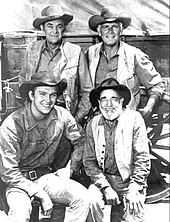
- George Gobel appeared as Major Adams' land cousin in "The Horace Best Story", the Season iv premiere episode.
- Don Grady appeared in "The Christine Elliot Story" (1960).
- Lorne Greene appeared in "The Vivian Carter Story" (1959).
- Tom Greenway appeared as Dr. Quinn in "The Dan Hogan Story" (1958).
- Kevin Hagen appeared four times on Wagon Train every bit Lansing in "The Willy Moran Story" (1957) and as Claymore in "The Nels Stack Story" (1957) and "The Annie MacGregory Story" (1958) and as Ed Prentiss in "The Silver Lady" (1965).[20]
- Sessue Hayakawa appeared as the championship grapheme in "The Sakae Ito Story" (1958).
- Peter Captain appeared three times on Wagon Train in 1962 and 1963: "The Daniel Clay Story", "The Wagon Train Mutiny", and in the title role "The Tom O'Neal Story", with Myron Healey bandage equally his father.
- Dwayne Hickman appeared in the championship guest-starring role in "The Clay Shelby Story" in Dec 1964. Celia Kaye played Ann Shelby, and Richard Carlson and Mort Mills were bandage as armed forces officers.[21]
- Darby Hinton, a child role player, appeared in March 1964 as Benjie Diel in the 75-minute episode "The Ben Engel Story".
- Dennis Holmes, some other child role player, appeared three times on Wagon Train, including the role of Danny Blake in "Those Who Stay Behind", along with Peter Brown and Bruce Dern (8 November 1964).[22]
- Dennis Hopper appeared as the championship character in "The Emmett Lawton Story", equally the crippled son of the murdered sheriff in a town taken over past outlaws, March 1963.[23]
- Rodolfo Hoyos, Jr., equally Padre in "The Don Alvarado Story", 21 June 1961, with Ed Nelson every bit Sheriff Donovan[24]
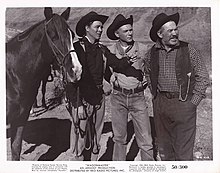
- Sherry Jackson appeared as the title character in "The Geneva Balfour Story", which was originally broadcast on 20 Jan 1964.[25]
- Anne Jeffreys and her husband, Robert Sterling, play a couple with an unusual "half-marriage" courting arrangement brought about by an attack of fever in the episode "The Julie Gage Story", the fourteenth episode of the serial broadcast on xviii December 1957.[26]
- Brad Johnson and Susan Oliver in the championship role appear in the 9 November 1960, episode "The Cathy Eckhardt Story", with Johnson cast as Will Eckhardt.[27]
- I. Stanford Jolley appeared x times, but not in the lead part of an episode.[28]
- Carolyn Jones appeared during the show'south commencement four episodes, also as the title characters in "The Jenna Douglas Story" (1961) as traumatized adult female found by the wagon railroad train, and in "The Molly Kincaid Story" (1963) equally an escaped captive of the Indians intent on punishing the husband who abandoned her.
- Dick Jones was bandage as John Hunter in "The Wagon Train Mutiny" (1962).
- J.M. Kerrigan appeared in "The St. Nicholas Story" (1959).
- Brett King appeared five times on Wagon Train, his last as a lieutenant in "The Sandra Cummings Story" (1963).
- Charles Laughton appeared as Albert Farnsworth in "The Albert Farnsworth Story". (1960)
- Art Linkletter appeared every bit the title character in "The Sam Darland Story" (1962).
- Peter Lorre every bit the championship grapheme in "The Alexander Portlass Story" (March 1960).
- Dayton Lummis appeared in three episodes: as Maj. Barham in "The Martha Barham Story" (NBC, 1959), as T.J. Gingle in "The John Turnbull Storey" (NBC, 1962), and as the Rev. Philip Marshall in "The Myra Marshall Story" (ABC, 1963), with Suzanne Pleshette in the title function.
- Lee Marvin appeared as Mexican brigand Jose Morales in the Flavour 4 episode "The Jose Morales Story".[13] Afterwards 20 episodes he appeared equally newly hired wagonmaster Jud Bridegroom in the Season 4 episode that introduced the Chris Unhurt graphic symbol, "The Christopher Hale Story".[29]
- Mike Mazurki appeared in "The Duncan McIvor Story" (1964).
- Tyler McVey appeared half dozen times on Wagon Train, including a two-part 1960 episode "Trial for Murder".
- Audrey Meadows played the title character in "The Nancy Palmer Story" (1961).
- Joyce Meadows appeared three times: equally Martha Williams in "The Conchita Vasquez Story" (1959), equally Rheba Polke in "The Jed Polke Story" and as Melanie in "The Artie Matthewson Story" (both 1961).
- Ralph Meeker appeared in the title role of "A Homo Chosen Horse" (season one, ep 26, trans 26 March 1958) in a story that served every bit the basis for the Richard Harris film A Man Called Horse, a decade later.
- Burgess Meredith guest starred in "The Grover Allen Story" (1964).
- Archie Moore, African-American prizefighter, appeared as a cowboy in "The Geneva Balfour Story", which was originally broadcast on twenty January 1964.[25]
- Read Morgan appeared three times: as Ben Denike in "The Vincent Eaglewood Story" with Wally Cox in the title role (1959), equally Curly Equus caballus in "The Martha Barham Story" with Ann Blyth (1959), and equally Jake in "The Myra Marshall Story".
- Ricardo Montalban appeared as the title character in the second episode of the serial, entitle "The Jean LeBec Story".
- Leonard Nimoy appeared in iv episodes-—twice as a Mexican, once equally an Indian and once as one of iii Spanish brothers.
- Prolific western histrion Gregg Palmer appeared in three episodes: equally Groton in "The Mary Halstead Story" (1957), as Paul Dawson in "The Riley Gratton Story" (1957) and as Raleigh in "The Jose Morales Story" (1960).
- Michael Parks was bandage every bit Hamish Browne in "The Heather and Hamish Story" with young man guest star Anne Helm (1963), and equally Michael Malone in "The Michael Malone Story", with Joyce Bulifant (1964).
- John Pickard appeared every bit Jed Otis in the 1959 episode "The Matthew Lowry Story".
- Ronald Reagan, in 1 of his final interim roles prior to his entering politics, played Capt. Paul Winters in the seventh-season episode "The Fort Pierce Story", commencement broadcast in September 1963.
- Michael Rennie appeared in two episodes: "The John Cameron Story" (1957) and "The Robert Harrison Clarke Story" (1963).
- Cesar Romero appeared in "The Honorable Don Charlie Story" (1958).
- Mickey Rooney guest starred equally "greenhorn" Samuel T. Evans in "The Greenhorn Story" (1959), and once again equally Samuel T. Evans with young wife Melanie (Olive Sturgess) in "Wagons Ho!", the 1960 season premiere. Ellen Corby played the role of Aunt 'Em in both episodes.[xxx] Sturgess in her role had to article of clothing the everyman of heels so as non to tower over the 5'2" Rooney.[31]
- Pippa Scott guest-starred in "The Link Cheney Story" (1964).
- Ann Sheridan guest-starred in "The Mavis Grant Story" (1962).
- Tom Simcox and Paul Stader guest-starred in "The Link Cheney Story" (1964).
- Roger Smith - (run across "Charles Bickford" earlier in the list)
- Arnold Stang played the lead in "The Ah Chong Story", the tale of an ebullient Chinese cook who joins the wagon railroad train with a rickshaw. Ah Chong produces higher quality and more reliable food service than Charlie Wooster, who has get arrogant because of success at poker playing. Ah Chong introduces wagonmaster Chris Unhurt and his banana, Bill Hawks, to bird nest soup. Wooster soon sees Ah Chong equally a threat in both cooking and poker, and hurls insults at him. Frank Ferguson plays a sheriff at the beginning of this episode, which aired near the end of the fourth season on 14 June 1961.[32]
- Barbara Stanwyck appeared three times.
- Rod Steiger portrayed a blind doctor heading westward in "The Saul Bevins Story" (1961). The other travelers object to his inclusion on the train because of the obstacles he must overcome. Vivi Janiss plays his sis, Martha Bevins; Charles Herbert, his son Job Bevins. Janiss too appeared in 5 other Wagon Train episodes.
- Charles Stevens appeared twice in "The Nels Stack Story" (1957) and "The Mark Hanford Story" (1958).
- Dean Stockwell appeared in four episodes, including "The Rodney Lawrence Story" (10 June 1959), in which he portrays a young white man whose parents were massacred by other whites, and he is reared past a single Indian. The Indian urges Rodney to rejoin his people when the carriage train passes through the area, and shortly after he joins the train he is accused of murder and theft. Spotter Flint McCullough proves that Rodney is innocent, and he becomes attracted to a young white woman, Mandy McCrea Cynthia Chenault. Roger Mobley plays Lawrence as a child in a flashback.[33]
- Karl Swenson played mountain man Jim Bridger in "The Jim Bridger Story". Francis De Sales likewise appeared in the episode as Mark.
- Akim Tamiroff appeared in "The Joe Muharich Story" (1961).
- Phyllis Thaxter was cast in the championship role of "The Christine Elliott Story" (1960), in which a immature adult female takes a group of orphan-boys, who had previously lived in her tardily father's orphanage, to a new life in the West. Don Grady and Gary Hunley also appear in this episode.
- Franchot Tone appeared in the lead function in "The Malachi Hobart Story" as a traveling preacher who loses confidence in his ain Christian message.
- Lee Van Cleef appeared in "The Jesse Cowan Story" (1958).
- Johnny Washbrook appeared as Tommy Peeks in "The Swift Cloud Story", with Rafael Campos in the 1959 title role, and as Ron Pearson in "The Beth Pearson Story", with Virginia Grey in the 1961 championship role.
- John Wayne appeared briefly, partly obscured past distance and shadow, in a long shot in the episode directed past John Ford, "The Colter Craven Story", in which he portrays General William Tecumseh Sherman. In this episode, Wayne is billed nether the pseudonym "Michael Morris", a reference to his real name, Marion Michael Morrison.[34] Several other regulars from "The John Ford Stock Company" also appeared, including John Carradine, Ken Curtis and Hank Worden. Ford also used some stock footage from his 1950 film Railroad vehicle Principal in this episode, which was shown 18 days after Ward Bond's death, and is the only episode in this serial directed past Ford.[35] Wayne also played Sherman under Ford's direction in the movie How the W Was Won, and was billed as "Michael Morris" for a lengthy Ford-directed cameo in the James Stewart television album show Flashing Spikes (1962).
- Guinn Williams, appeared in "The Vincent Eaglewood Story" (1959).
- Shelley Winters appeared during the show'due south offset 4 episodes.
- Jane Wyman appeared twice, once in "The Doctor Willoughby Story" (1958), as a woman doctor heading west. And, once again in "The Carriage Train Mutiny" (1964).
- Vera Miles appeared three times on Railroad vehicle Railroad train as the pb part in "The Sister Rita Story" (1959), as Janice Stuart in "The Bob Stuart Story" (1964)[36] and as Anne Reed in "The Silver Lady" (1965).[20]
- Harry von Zell invitee-starred in "The Link Cheney Story" (1964) and "The Tobias Jones Story" (1958).
- Dick York guest-starred in "The Michael Malone Story" (1964) equally Mitchell.
- Tony Young guest-starred as Quent Loomis in "The Melanie Craig Story", with Myrna Fahey in the title function (1964).[37]
- The episode "Alias Bill Hawks" is a story of townspeople covering for a murder, and trying to dig a needed artesian well. Terry Wilson, every bit the real "Bill Hawks", arrives to put the puzzle together. Ed Nelson guest stars.
- Jeanne Cooper of The Immature and the Restless fame, guest stars in an episode titled "The Whipping", shown during season 7 (1963–64) of Railroad vehicle Train.
Theme music [edit]
The kickoff season theme "Railroad vehicle Train" was written by Henri René and Bob Russell, and lyrics were non used. The theme was conducted by Revue musical director Stanley Wilson. In the second season, a new more modern sounding theme was introduced. "(Roll Along) Railroad vehicle Train" was written by Sammy Fain and Jack Brooks and sung by Johnny O'Neill. Well-nigh midway through the second season this was replaced with an instrumental version by Stanley Wilson. In the 3rd season a more traditional sounding score was introduced. "Wagons Ho!" was written and conducted by Jerome Moross, who adjusted information technology from a passage of music he had written for the 1959 film The Jayhawkers. This theme would final through the serial' run and is the most remembered Wagon Railroad train theme. Stanley Wilson re-recorded "Wagons Ho!" when the series went to color in 1963, so an abbreviated version of the 1963 re-recorded theme was used for the final season when information technology returned to black-and-white.[ citation needed ]
Release [edit]
Original broadcast [edit]
The prove ran for 284 episodes over 8 seasons: the beginning aired on 18 September 1957, and the final segment was circulate on 2 May 1965.
The series aired for virtually of its run in black-and-white. That briefly changed during the evidence's fifth flavor (1961–62) on the NBC network, to help promote the sales of parent company RCA's color television sets.[ citation needed ]
V episodes on the NBC network were aired in color:[ citation needed ]
- four October 1961: "The Kitty Albright Story" (with Polly Bergen as Albright)
- i Nov 1961: "The Jenna Douglas Story" (with Carolyn Jones)
- 6 Dec 1961: "The Lizbeth Ann Calhoun Story" (with Dana Wynter)
- 7 February 1962: "The Lonnie Fallon Story" (with Gary Clarke)
- 14 March 1962: "The Amos Billings Story" (with Paul Gear up)
The serial returned to its original black-and-white format for its sixth twelvemonth and first flavour (1962–63) on rival upstart ABC television network (American Broadcasting Company), damaging the ratings, but the post-obit season, every bit the series expanded to 90 minutes, was entirely in colour. In the last flavour the series reverted to both black and white and the lx-minute format.
Syndication [edit]
When the original Ward Bond episodes were circulate weekday afternoons on ABC beginning in 1963, a new serial title "Seth Adams Trailmaster" was given to the episode to avoid viewer confusion because Wagon Train was still on the ABC evening schedule. A new theme song, the "Trailmaster Theme", written and conducted by Stanley Wilson, was used for these syndicated episodes. The later on episodes from the John McIntyre era were syndicated nether the simpler title "Trailmaster". All episodes eventually reverted to their original titling later the series left the air. The 75-minute episodes were usually syndicated separately, sometimes shown on local stations as "movies".[ commendation needed ]
Home media [edit]
In 2004 Alpha Video released three episodes of Wagon Train on DVD.[38] Four years later Timeless Media Group released a DVD drove consisting of 12 episodes on three discs.[39] Also in 2008, they released "The Complete Color Season", a 16 disc box set that included all 32 episodes from flavour 7 plus, as a bonus, xvi episodes from the other seasons.[40]
Betwixt 2010 and 2013 Timeless Media Group released the complete run of the series in eight box sets of one flavour each with the seventh season re-issued without the bonus episodes.
| Flavor | Number of episodes | Number of discs | Release date | Ref. |
|---|---|---|---|---|
| 1 | 39 | 10 | 12 July 2010 (2010-07-12) | [41] [42] |
| 2 | 38 | 10 | 23 November 2010 (2010-11-23) | [43] [44] |
| iii | 37 | 10 | 17 March 2011 (2011-03-17) | [45] [46] |
| iv | 38 | 10 | 25 October 2011 (2011-10-25) | [47] [48] |
| 5 | 37 | 10 | 1 May 2012 (2012-05-01) | [49] [50] |
| 6 | 37 | 10 | 5 March 2013 (2013-03-05) | [51] [52] |
| 7 | 32 | 8 | xi November 2008 | [53] [54] |
| 8 | 26 | eight | eleven June 2013 (2013-06-11) | [55] [56] |
Cultural influences [edit]
Cistron Roddenberry claimed he pitched Star Trek as "Wagon Train to the stars", referring the concept of a recurring cast on a journeying with notable invitee stars becoming the focus of various stories. In his 11 March 1964 initial pitch document for the series he wrote, "STAR TREK is a 'Wagon Train' concept—built around characters who travel to worlds 'similar' to our own".[57]
In the film Stand by Me (1986), Gordie (Wil Wheaton) quips while the boys are camping (in their quest to find the dead body of Ray Brower):
"Wagon Railroad train is a cool show, but you ever notice they never become anywhere? They just go along on wagon-training."[58]
References [edit]
- ^ "TV Westerns - Wagon Railroad train| FiftiesWeb". Fifities Web . Retrieved eighteen June 2018.
- ^ Aaker, Everett (2017). Television Western Players, 1960–1975: A Biographical Lexicon. McFarland. pp. 41–43. ISBN9781476628561.
- ^ "Carriage Train". Television Guide . Retrieved 18 June 2018.
- ^ John Wayne, the Life and Legend
- ^ "The Museum of Broadcast Communications - Encyclopedia of Television - Wagon Railroad train". www.museum.tv . Retrieved 18 June 2018.
- ^ "The Kate Parker Story" at IMDb
- ^ "The Andrew Unhurt Story" at IMDb
- ^ "The Conchita Vasquez Story" at IMDb
- ^ "The Daniel Barrister Story" at IMDb
- ^ "The Willy Moran Story" at IMDb
- ^ MichaelWinkelman (1946-1999) at IMDb
- ^ "Around the Horn" at IMDb
- ^ a b "The Jose Morales Story" at IMDb
- ^ "The Prairie Story" at IMDb
- ^ "The Dora Grey Story" at IMDb
- ^ "The Isaiah Quickfox Story" at IMDb
- ^ "The Cliff Grundy Story on Dan Duryea Central"
- ^ "The Bleymier Story" at IMDb
- ^ "The Clara Beauchamp Story" at IMDb
- ^ a b "The Silver Lady" at IMDb
- ^ "The Dirt Shelby Story" at IMDb
- ^ "Those Who Stay Behind" at IMDb
- ^ "The Emmett Lawton Story" at IMDb
- ^ "The Don Alvarado Story" at IMDb
- ^ a b "The Geneva Balfour Story" at IMDb
- ^ "The Julie Gage Story" at IMDb
- ^ "The Cathy Eckhardt Story" at IMDb
- ^ I. Stanford Jolley at IMDb
- ^ "TV Westerns - Wagon Railroad train s4 Episodes- FiftiesWeb". fiftiesweb.com . Retrieved 28 March 2018.
- ^ "Wagons Ho!". IMDb. 28 September 1960. Retrieved v September 2014.
- ^ Mike Fitzgerald. "Olive Sturgess". westernclippings.com. Retrieved 5 September 2014.
- ^ "The Ah Chong Story" at IMDb
- ^ "The Rodney Lawrence Story" at IMDb
- ^ McBride, Joseph,(2003) Searching for JOHN FORD, London, England: Faber and Faber
- ^ "Goggle box Westerns - Carriage Train Episode Pictures- FiftiesWeb". fiftiesweb.com . Retrieved 28 March 2018.
- ^ "The Bob Stuart Story" at IMDb
- ^ Tony Young at IMDb
- ^ "Wagon Railroad train". Amazon. 26 October 2004. Retrieved 22 February 2014.
- ^ "Wagon Railroad train – Going Westward". Amazon. 7 October 2008. Retrieved 22 Feb 2014.
- ^ "Wagon Train – The Complete Color Flavor". Amazon. 4 November 2008. Retrieved 22 February 2014.
- ^ Rosin 2012, pp. 89, 91–92
- ^ "Carriage Railroad train – The Complete First Flavor". Amazon. six July 2010. Retrieved 22 Feb 2014.
- ^ Rosin 2012, pp. 89, 109–110
- ^ "Carriage Railroad train – The Complete 2nd Season". Amazon. 23 November 2010. Retrieved 22 February 2014.
- ^ Rosin 2012, pp. 89, 125–126
- ^ "Wagon Train – The Consummate Third Flavor". Amazon. 25 June 2013. Retrieved 22 Feb 2014.
- ^ Rosin 2012, pp. 89, 141–142
- ^ "Wagon Railroad train – The Complete 4th Season". Amazon. 25 Oct 2011. Retrieved 22 February 2014.
- ^ Rosin 2012, pp. 89, 157–158
- ^ "Railroad vehicle Train – The Complete Fifth Season". Amazon. May 2012. Retrieved 22 February 2014.
- ^ Rosin 2012, pp. 89, 171–172
- ^ "Wagon Train – The Consummate Sixth Season". Amazon. 5 March 2013. Retrieved 22 Feb 2014.
- ^ Rosin 2012, pp. 89, 183–184
- ^ "Wagon Train – The Complete Seventh Season". Amazon . Retrieved 22 Feb 2014.
- ^ Rosin 2012, pp. 89, 197–198
- ^ "Wagon Train – The Complete Eighth Season". Amazon. 25 June 2013. Retrieved 22 February 2014.
- ^ Whitfield, Stephen, and Roddenberry, Gene. The Making of Star Trek (New York: Del Rey Books), 1986. ISBN 978-0345340191
- ^ "Quotes from "Stand by Me"". IMDb.
Sources [edit]
- Rosin, James (2012). Wagon Train: the Boob tube Serial. Autumn Road Co. ISBN978-0-9728684-7-1.
External links [edit]
- Wagon Train at IMDb
- Wagon Train at epguides.com
brinkleyouned1940.blogspot.com
Source: https://en.wikipedia.org/wiki/Wagon_Train
0 Response to "Wagon Train Season 4 Episode 21 No Baby at End"
Post a Comment