How to Read Coordinates for Property Lines
In geometry, line coordinates are used to specify the position of a line simply as indicate coordinates (or simply coordinates) are used to specify the position of a betoken.
Lines in the plane [edit]
At that place are several possible means to specify the position of a line in the aeroplane. A unproblematic style is by the pair (m, b) where the equation of the line is y = mx +b. Hither m is the slope and b is the y-intercept. This organisation specifies coordinates for all lines that are not vertical. Withal, it is more than mutual and simpler algebraically to employ coordinates (50, m) where the equation of the line is sixty +my + i = 0. This arrangement specifies coordinates for all lines except those that pass through the origin. The geometrical interpretations of l and m are the negative reciprocals of the x and y-intercept respectively.
The exclusion of lines passing through the origin can be resolved by using a organisation of three coordinates (l, m, n) to specify the line with the equation threescore +my +northward = 0. Here l and m may not both be 0. In this equation, only the ratios between l, one thousand and n are significant, in other words if the coordinates are multiplied by a not-zero scalar and so line represented remains the same. So (l, k, due north) is a arrangement of homogeneous coordinates for the line.
If points in the existent projective aeroplane are represented past homogeneous coordinates (x, y, z), the equation of the line is lx +my +nz = 0, provided (l, yard, north) ≠ (0,0,0) . In item, line coordinate (0, 0, 1) represents the line z = 0, which is the line at infinity in the projective plane. Line coordinates (0, 1, 0) and (one, 0, 0) represent the ten and y-axes respectively.
Tangential equations [edit]
Just equally f(x,y) = 0 tin represent a bend equally a subset of the points in the aeroplane, the equation φ(l,one thousand) = 0 represents a subset of the lines on the airplane. The set up of lines on the plane may, in an abstract sense, exist thought of every bit the set of points in a projective plane, the dual of the original plane. The equation φ(l,m) = 0 then represents a curve in the dual plane.
For a curve f(x,y) = 0 in the plane, the tangents to the curve class a curve in the dual infinite called the dual curve. If φ(l,k) = 0 is the equation of the dual curve, then it is called the tangential equation, for the original curve. A given equation φ(l,m) = 0 represents a bend in the original plane determined as the envelope of the lines that satisfy this equation. Similarly, if φ(50,m,n) is a homogeneous function then φ(50,m,due north) = 0 represents a curve in the dual space given in homogeneous coordinates, and may exist called the homogeneous tangential equation of the enveloped bend.
Tangential equations are useful in the study of curves divers as envelopes, just as Cartesian equations are useful in the study of curves divers as loci.
Tangential equation of a indicate [edit]
A linear equation in line coordinates has the form al +bm +c = 0, where a, b and c are constants. Suppose (fifty,m) is a line that satisfies this equation. If c is not 0 then lx +my + ane = 0, where 10 =a/c and y =b/c, then every line satisfying the original equation passes through the point (ten,y). Conversely, whatever line through (x,y) satisfies the original equation, so al +bm +c = 0 is the equation of set up of lines through (x,y). For a given signal (ten,y), the equation of the set of lines though it is lx +my + 1 = 0, so this may exist defined as the tangential equation of the point. Similarly, for a point (x,y,z) given in homogeneous coordinates, the equation of the point in homogeneous tangential coordinates is lx +my +nz = 0.
Formulas [edit]
The intersection of the lines (50 1,m 1) and (l 2,m two) is the solution to the linear equations


Past Cramer's rule, the solution is

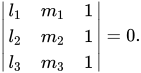
The lines (fifty 1,m 1), (l two,chiliad 2), and (l 3,m 3) are concurrent when the determinant
For homogeneous coordinates, the intersection of the lines (l 1,m 1,north 1) and (fifty 2,m 2,n 2) is

The lines (l 1,m 1,n 1), (l 2,m ii,north 2) and (l 3,m 3,n 3) are concurrent when the determinant

Dually, the coordinates of the line containing (x i,y one,z 1) and (x 2,y two,z two) are

Lines in three-dimensional space [edit]
For two given points in the real projective airplane, (ten 1,y ane,z 1) and (ten 2,y 2,z 2), the three determinants

make up one's mind the projective line containing them.
Similarly, for ii points in RP 3, (x ane,y one,z 1,w ane) and (x two,y 2,z 2,w 2), the line containing them is determined by the half dozen determinants

This is the ground for a system of homogeneous line coordinates in three-dimensional space called Plücker coordinates. 6 numbers in a fix of coordinates only correspond a line when they satisfy an additional equation. This system maps the space of lines in 3-dimensional space to projective space RP 5, but with the additional requirement the infinite of lines corresponds to the Klein quadric, which is a manifold of dimension four.
More than mostly, the lines in n-dimensional projective space are determined past a organization of due north(n − 1)/two homogeneous coordinates that satisfy a set of (n − 2)(north − 3)/2 weather condition, resulting in a manifold of dimension 2n− two.
With complex numbers [edit]
Isaak Yaglom has shown[1] how dual numbers provide coordinates for oriented lines in the Euclidean plane, and divide-complex numbers form line coordinates for the hyperbolic plane. The coordinates depend on the presence of an origin and reference line on it. Then, given an arbitrary line its coordinates are found from the intersection with the reference line. The distance due south from the origin to the intersection and the angle θ of inclination between the two lines are used:
- is the dual number[one] : 81 for a Euclidean line, and
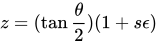
- is the split-complex number[1] : 118 for a line in the Lobachevski plane.

Since there are lines ultraparallel to the reference line in the Lobachevski plane, they demand coordinates too: In that location is a unique common perpendicular, say s is the distance from the origin to this perpendicular, and d is the length of the segment between reference and the given line.
- denotes the ultraparallel line.[1] : 118

The motions of the line geometry are described with linear fractional transformations on the appropriate complex planes.[1] : 87, 123
Come across likewise [edit]
- Robotics conventions
References [edit]
- ^ a b c d e Isaak Yaglom (1968) Complex Numbers in Geometry, Academic Press
- Baker, Henry Frederick (1923), Principles of geometry. Book iii. Solid geometry. Quadrics, cubic curves in space, cubic surfaces., Cambridge Library Drove, Cambridge University Press, p. 56, ISBN978-1-108-01779-4, MR 2857520 . Reprinted 2010.
- Jones, Alfred Clement (1912). An Introduction to Algebraical Geometry. Clarendon. p. 390.
brinkleyouned1940.blogspot.com
Source: https://en.wikipedia.org/wiki/Line_coordinates
0 Response to "How to Read Coordinates for Property Lines"
Post a Comment